1099 or Bank Statements — Which One Gets You Approved?
If you work for yourself, your taxes might not tell the whole story. Here's how to pick the income proof that actually works in your favor.

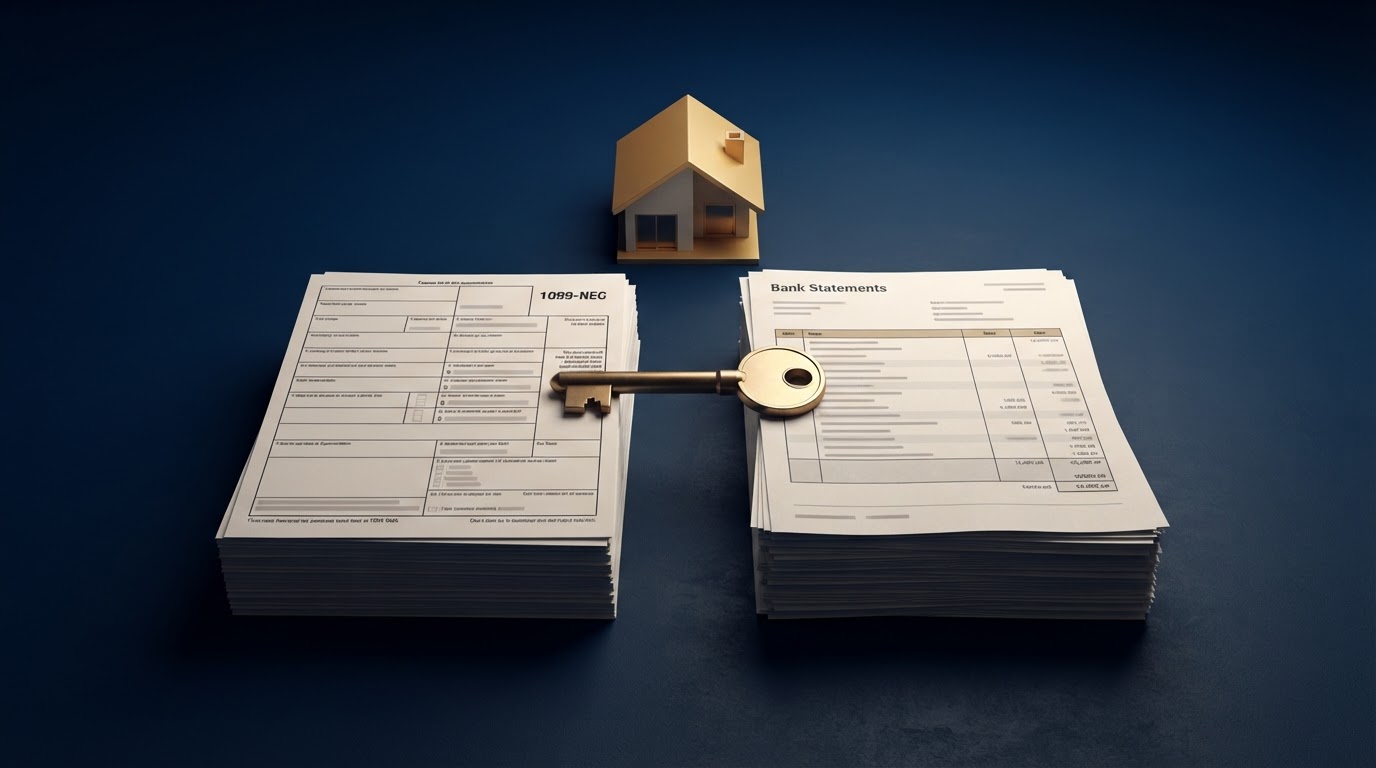
You work for yourself — maybe you drive for a rideshare app, run a cleaning business, do construction, or freelance. You bring in good money. But when you sit down to apply for a mortgage, the lender asks for "proof of income" and suddenly everything feels complicated. Sound familiar?
Here's the question I hear all the time from self-employed clients: "I have my 1099s — is that enough? Or do I need bank statements instead?" Honestly, it depends on your situation, and picking the wrong path can cost you a loan approval.
Let me break it down in plain terms so you can walk into this process knowing exactly which option makes more sense for you.
What Does a 1099 Actually Tell a Lender?
A 1099 form shows how much money someone paid you during the year. If you received $80,000 in 1099 income last year, that number goes on your tax return — but here's the catch most people don't see coming.
When lenders use your 1099s to qualify you, they typically look at your net income after deductions, not the gross amount on the form. So if you wrote off $30,000 in business expenses, the lender might only count $50,000 — or less. That directly affects how much house you can qualify for.
- Best for: self-employed borrowers with strong net income and minimal write-offs
- Requires: 1-2 years of 1099s plus tax returns
- Watch out for: heavy deductions reducing your qualifying income significantly
How Bank Statement Loans Work — and When They Help More
A bank statement loan skips the tax returns entirely. Instead, the lender looks at 12 or 24 months of your personal or business bank statements and calculates your average monthly deposits.
Let's say your bank statements show $10,000/month in deposits over 24 months. The lender might apply an expense ratio — typically 50% for personal, around 50-75% for business accounts — and count $5,000/month as your qualifying income. On a $350,000 home with 10% down ($35,000), that $5,000/month could realistically support the mortgage payment depending on your other debts.
This is a game-changer if you write off a lot on your taxes. Your tax return might show $40,000 in net income, but your bank statements show $120,000 flowing through your account. The bank statement loan sees the real picture.
- Best for: self-employed borrowers with high gross income but heavy tax deductions
- Requires: 12-24 months of consistent bank statements
- Watch out for: slightly higher interest rates compared to conventional loans (usually 0.5–1% higher)
See Which Option Fits Your Income
Tell Liuver how you get paid and he'll show you which path gives you the strongest approval.
A Real Example: Same Person, Two Very Different Results
Meet Carlos. He runs a landscaping business and grosses $95,000 a year in 1099 income. After deductions, his tax return shows $38,000 net. Using traditional 1099 income qualification, he might qualify for a loan around $150,000–$170,000.
But Carlos's bank statements show $7,500/month in average deposits. Using a bank statement loan with a 50% expense ratio, his qualifying income jumps to $3,750/month — which could support a $220,000–$240,000 home purchase with 10% down.
Same person. Same earnings. Very different buying power depending on which document the lender uses.
Which One Should You Choose?
There's no universal answer, but here's how I guide my clients:
- If your net income after taxes is strong (above $60,000/year), 1099 + tax returns usually works fine and gets you a better rate
- If you write off heavily and your net income looks low on paper, a bank statement loan will likely show a truer picture of what you earn
- If you've only been self-employed for one year, some bank statement programs accept just 12 months of history — that matters
One thing I always check first: I look at both paths side by side before recommending anything. Sometimes clients are surprised which one actually qualifies them for more.
Run the Numbers on Your Income
Get a quick analysis of your 1099 vs. bank statement options before you apply anywhere.
Ready to Figure Out Your Next Step?
If you're self-employed and trying to figure out how to qualify for a mortgage, don't guess. The difference between using your 1099s and your bank statements can literally mean the difference between getting approved or not — or buying a $200,000 home versus a $300,000 one.
Reach out to me directly. Tell me how you get paid, what your deposits look like, and what you're trying to buy. I'll give you a straight answer — no pressure, no runaround. That's what I'd want if I were in your shoes.
Run your numbers
Your next step
Not Sure Which Option Fits You?
Every self-employed situation is different. Send me a message and I'll tell you honestly which path gives you the best shot at approval.